Freeze with a plan, label without mercy, and cook from what you already have
Too many kitchens treat the freezer as a cryogenic mortuary: a place where food goes to be forgotten, emerging months later as an anonymous block wearing frost like a shroud. Reimagined properly, it is one of the strongest anti-waste tools in the house. It lets us preserve food while it is still good, portion large batches deliberately, buy seasonal ingredients with purpose and keep the useful remainder of a recipe from becoming tomorrow’s bin liner.
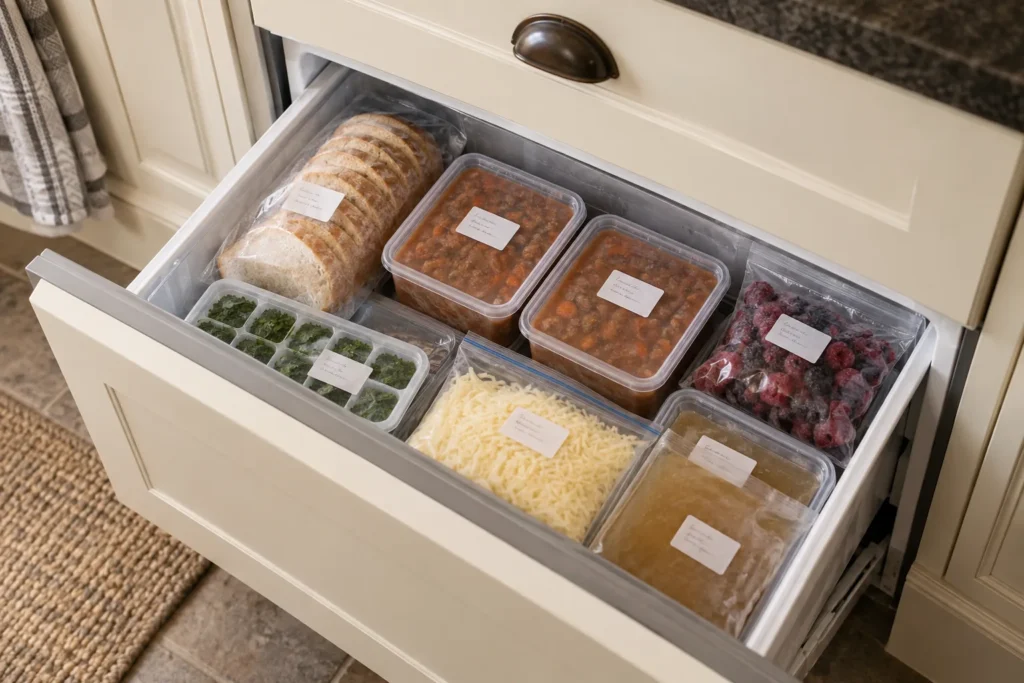
The difference between a freezer and a frozen larder is organisation. A freezer receives whatever cannot be faced today. A frozen larder contains food chosen for a future use. That choice affects how it is portioned, protected, labelled, stored and thawed.
Freezing does not improve food and it does not reset its age. Begin with ingredients and cooked dishes that are still in good condition. The freezer pauses deterioration; it cannot rescue something already past the point at which you would willingly eat it.
Freeze the future meal
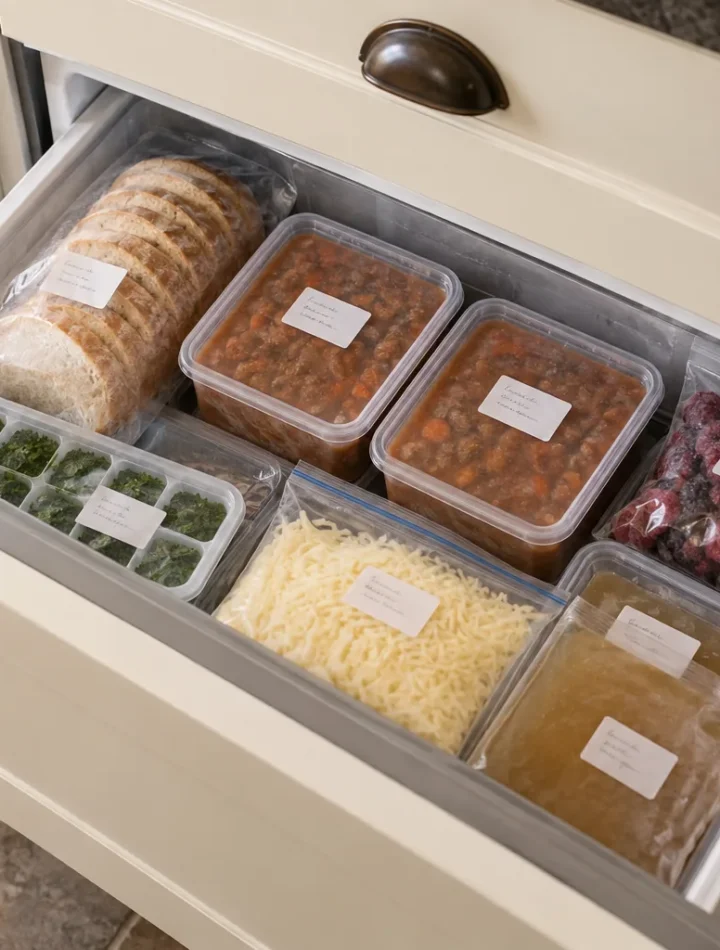
Before freezing anything, decide how it will return to the kitchen. A family-sized block of chilli is useful only when the whole family is eating it. If future lunches are more likely, divide it now. Bread is more practical sliced, so that individual pieces can be removed without thawing the loaf. Grated hard cheese can be scattered into cooking. Ripe bananas should be peeled unless the future cook enjoys wrestling with frozen skins.
Chilli Con Carne, soups, braises and many cooked sauces are good candidates because their structure tolerates freezing and reheating. Flatbreads can be separated with parchment and reheated individually. Pagnotta and Brioche are easier to use when sliced before freezing and wrapped well enough to protect the cut edges.
Freeze in amounts that match real habits: one bowl, two portions, enough sauce for one pasta supper. Smaller, flatter packages freeze and thaw more evenly and stack like files. Leave suitable headspace in rigid containers holding liquids, because water expands as it freezes.
Air is the enemy of quality
Freezer burn is dehydration. Poorly wrapped food loses moisture to the cold, dry environment, leaving pale, tough or leathery patches. It may remain safe if continuously frozen, but its quality suffers. Press excess air from freezer bags, wrap irregular items closely, use containers that fit the portion, and make sure lids seal.
Cool cooked food promptly before freezing, but do not leave it at room temperature for hours in the name of protecting the appliance. Divide a large batch into shallow containers so it cools more quickly. Follow current food-safety guidance for the dish, particularly where cooked rice, meat, fish or dairy is involved.
A reasonably full freezer holds its temperature more steadily than an almost empty one, but it still needs circulating cold air and a door that closes without persuasion. Keep it at the appliance manufacturer’s recommended setting, commonly around minus 18 degrees Celsius, and use a freezer thermometer if the controls are vague.
Label without mercy
Every unlabelled package looks obvious on the day it enters. Six weeks later, tomato sauce, red wine gravy and blended pepper soup belong to the same dark red family. A label should state what the food is, the freezing date and, where useful, the number of portions. Add a reheating note if the future version of you would benefit from it.
Use labels that remain attached in the cold and a pen that does not rub away. Write before the container becomes damp or frosty. “Soup, February” is better than nothing; “Butternut and prosciutto soup, two portions, 14 February” is a plan.
Maintain a simple inventory on the freezer door or in a kitchen notebook. It need not record every ice cube. Its purpose is to make substantial meals and valuable ingredients visible without excavating the drawers. Cross items off when they leave. An inaccurate inventory is merely another form of mystery.
Know what changes
Safety and quality are different questions. Food kept continuously frozen at a suitable temperature may remain safe for a long time, but flavour and texture still decline. Fat can develop stale flavours, bread can dry, herbs can darken and ice crystals can damage delicate structures. Freezing earlier and protecting food well usually matters more than forcing every item towards an arbitrary maximum date.
Some ingredients are transformed rather than ruined. Frozen herbs lose the texture required for garnish but remain useful in soups and sauces, especially when chopped or blended with a little oil before freezing. Soft fruits collapse on thawing but work in compotes, smoothies and baking. Egg whites freeze well in measured batches. Hard cheese is often more successful grated for cooking than frozen as a block for a cheeseboard.
Other foods are poor candidates when their fresh texture is the point. Lettuce, cucumber and many crisp salad vegetables release water and become limp. Whole raw potatoes can become unpleasantly textured. Creamy emulsions may split. Soft cheeses may become grainy. This does not always make them unusable, but it changes the job they can do. Freeze for a known cooked use rather than hoping the original texture will survive.
Thaw with the same intention
The plan continues when food leaves the freezer. Thaw foods safely according to what they are, usually in the refrigerator, in a microwave when they will be cooked immediately, or by cooking from frozen when the product or recipe permits. Do not leave perishable food on the worktop for an afternoon and assume the cold centre protects the warming exterior.
Reheat cooked food thoroughly and follow current guidance on repeated reheating. Rice deserves particular care: cool it quickly, refrigerate or freeze promptly, and reheat until steaming hot throughout. Labels can carry these reminders when a container is likely to be handed to someone else.
If a power cut occurs, keep the freezer door closed. The correct decision afterwards depends on the duration, the temperature reached and whether the food still contains ice crystals. When in doubt, consult official food-safety advice rather than tasting food as a test.
Eat the freezer
A freezer becomes useful only when food travels in both directions. Set aside one meal each week to cook from it, or conduct a monthly audit and move older items to a visible “use next” section. Build shopping lists around what is already there. The purpose is rotation, not accumulation.
Keep components as well as complete meals: stock in measured amounts, breadcrumbs, grated cheese, portions of cooked beans, pastry trimmings, chopped chillies, sliced bread and small cubes of concentrated sauce. These make an ordinary supper easier without dictating exactly what it must be.
The discipline is simple. Freeze food while it is worth saving. Portion it for the way it will actually be eaten. Exclude air, label it, record it and make a habit of using it. A freezer organised this way does more than prevent waste. It gives time back to the cook, which may be the most useful preservation of all.