The Past Revisited
In The Spice Is Right, I considered the background of spices and their place in the culinary world. Herbs deserve their own attention, not merely as the quieter green relatives of the spice jar, but as ingredients with a history and character of their own.
Cooking with herbs periodically returns to fashion, often in reaction to food that feels overly processed or uniform. Yet herbs are not a passing trend. Long before the modern cookery programme, people cultivated, gathered and preserved them for flavour, fragrance and a variety of traditional household uses.
Today, their most dependable value in the kitchen is the flavour they bring. Basil can transform ripe tomatoes; rosemary can stand up to lamb, potatoes and fire; dill lifts fish and cucumbers; parsley brings freshness without demanding the entire stage. Herbs can also help us rely less heavily on salt, sugar or rich sauces when a dish needs interest.
It is tempting to attach grand health promises to familiar plants. Herbs certainly contribute small amounts of vitamins, minerals and diverse plant compounds, but the quantity scattered over a finished dish is not a medicine. Parsley contains vitamin K and other nutrients; garlic has been widely studied; neither should be presented as a cure for colds, flu or high cholesterol. Enjoy herbs as part of a varied diet and seek medical advice for medical problems.
Herbs and Spices
In ordinary culinary language, herbs are usually the leaves and tender stems of plants, while spices more commonly come from seeds, fruits, bark, roots, rhizomes or flower buds. It is a useful distinction, but not an inviolable botanical law. Coriander gives us both fresh leaves, which are treated as an herb, and dried seeds, which are treated as a spice. Some cuisines use aromatic leaves, such as curry leaves, in ways that do not sit neatly inside an English-language definition.
Many spices associated with warmer regions reached Europe through long and often dangerous trade routes. At different times they were valuable luxuries and symbols of status, and competition for their trade became entangled with exploration, colonial expansion, exploitation and war.
One persistent tale says that medieval Europeans used spices chiefly to disguise rotten meat. That explanation is too simple. Spices were expensive; people wealthy enough to buy them were generally able to obtain fresh meat, while salting, smoking and drying were established preservation methods. Spices were prized because people enjoyed their flavour, valued their rarity and sometimes believed in their medicinal properties, not because every seasoned joint was hiding decay.
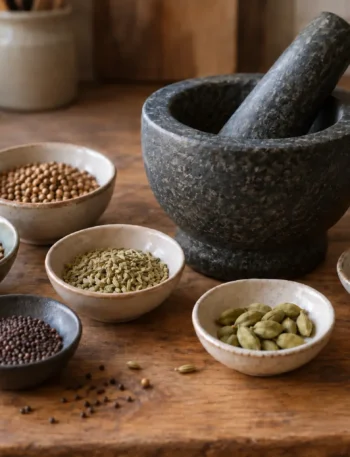
Today, spices that once crossed continents as precious cargo sit in inexpensive packets on supermarket shelves. Convenience, however, can make us forget how quickly aroma fades. Whole spices usually retain their character longer than ready-ground powders. Buy manageable quantities, store them away from heat, light and moisture, and grind or crush them when you can.
Growing Herbs
Fresh herbs offer aromas and textures that dried versions cannot always reproduce. If you have a garden, a small patch close to the kitchen is useful; if you do not, pots on a patio, balcony or bright windowsill can still provide a worthwhile harvest.
Choose plants for the conditions you can offer. Mediterranean herbs such as rosemary and thyme prefer excellent drainage and generous light. Mint enjoys more moisture and is usually best confined to a pot unless you want it to annex the garden. Parsley, chives and chervil can tolerate gentler conditions, while basil wants warmth and dislikes cold, wet roots.
Harvesting in the morning after surface moisture has dried is convenient, but there is no need to turn the clock into dogma. The best time is when the plant is healthy, the leaves are dry and you are ready to use or preserve them. Regular cutting can encourage leafy growth, although the right method varies by plant.
Rinse herbs when needed and dry them gently. Avoid leaving wet bunches packed together, where bruising and spoilage can develop quickly.
Freezing Herbs
Freezing often preserves the character of soft herbs better than drying, although the leaves lose their crisp texture. That makes them suitable for sauces, soups, stews and cooked dishes rather than garnishes.
Wash only if necessary, dry thoroughly, then chop or leave in small sprigs. Freeze them in labelled containers or bags, removing as much excess air as practical. Chopped herbs can also be frozen in small portions with water or a suitable cooking oil, but oil mixtures must remain frozen or refrigerated and should never be stored casually at room temperature.
Basil, parsley, chives, dill and coriander leaves are all useful candidates. Add frozen herbs directly to cooking rather than thawing them into a limp pile on the worktop.
Drying Herbs
Drying suits sturdy, relatively low-moisture herbs such as rosemary, thyme, sage, oregano and marjoram. Tender herbs can be dried, but often surrender more of the fragrance that makes them special.
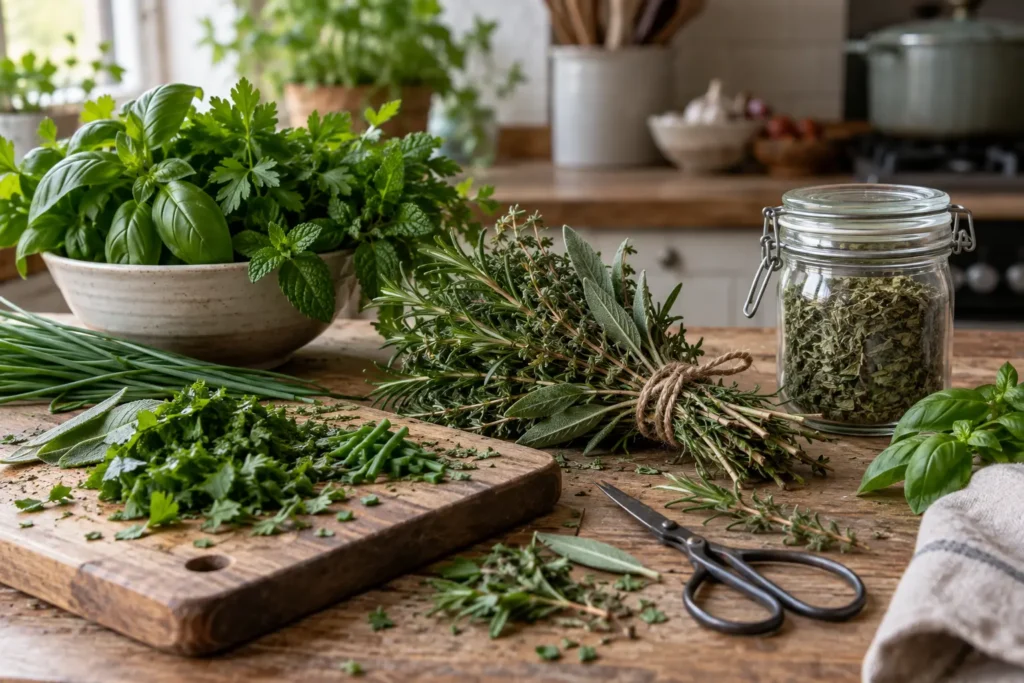
Air-dry small, loose bunches in a warm, dry, well-ventilated place away from direct sunlight, or use a dehydrator according to its instructions. The leaves must become fully dry and brittle before storage; any remaining moisture invites mould. Large, tightly tied bunches may dry too slowly, so resist the picturesque temptation to hang half the garden from one piece of string.
For seed crops such as coriander, dill or caraway, allow the seed heads to mature, then collect and dry them in a paper bag or over a tray so that the seeds are not lost. Separate them from stalks and chaff before storage.
Keep dried herbs in clean, airtight containers in a cool, dark, dry cupboard. Label them with the name and date. They do not become useless at a magical six-month boundary, but their flavour gradually declines. Crush a little between your fingers and smell it; if almost nothing answers, the jar has given all it has to give.
Cooking with Dried Herbs
Dried herbs are often more concentrated by volume than fresh ones, but no single conversion works perfectly for every herb or recipe. A rough starting point is one part dried to three parts fresh, then adjust by taste. Potent dried rosemary and sage may need greater restraint; delicate parsley may be disappointing however carefully the arithmetic is performed.
Add robust dried herbs early enough to soften and infuse the dish. Fresh tender herbs are often best added near the end, while woody sprigs can simmer for longer and be removed before serving.
The aim is not to prove that fresh is always superior or that the old ways were invariably wiser. It is to understand what each form can offer. Grow what suits your space, preserve what you cannot use at once and allow the larder to carry a little of one season into the next.
That is how past flavours remain alive: not as museum pieces, but as working ingredients in the food we cook today.