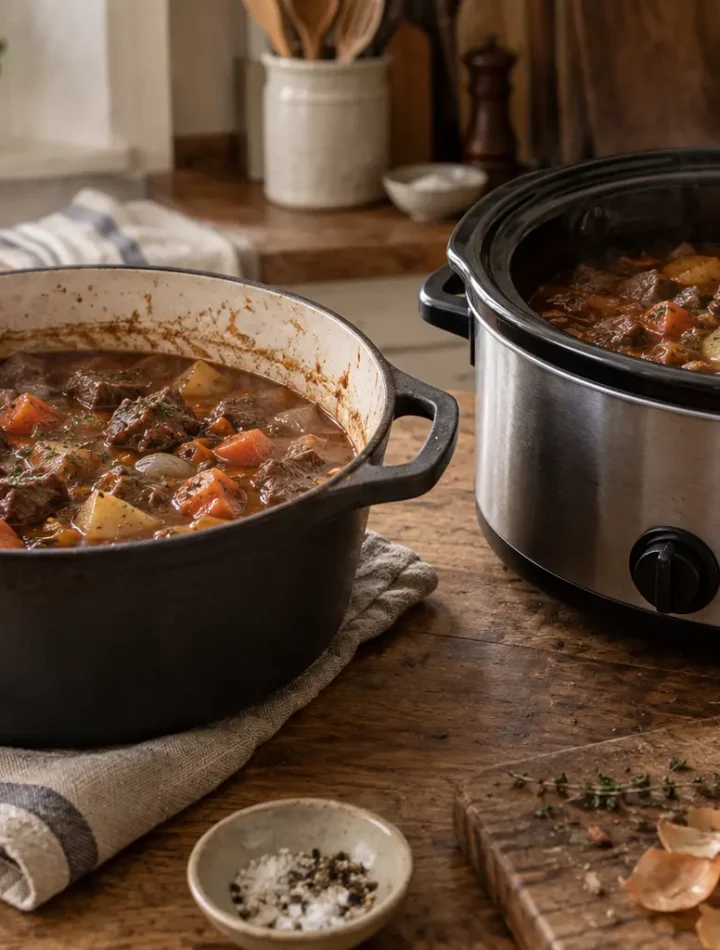
The Dutch Oven and the Slow Cooker: Which Came First?
Cast-iron cooking pots are centuries old. In early eighteenth-century England, Abraham Darby developed and patented an improved method of casting iron pots using sand moulds. The term Dutch oven has since come to describe several forms of heavy, lidded cooking pot, including the enamelled cast-iron casseroles familiar in many modern kitchens.
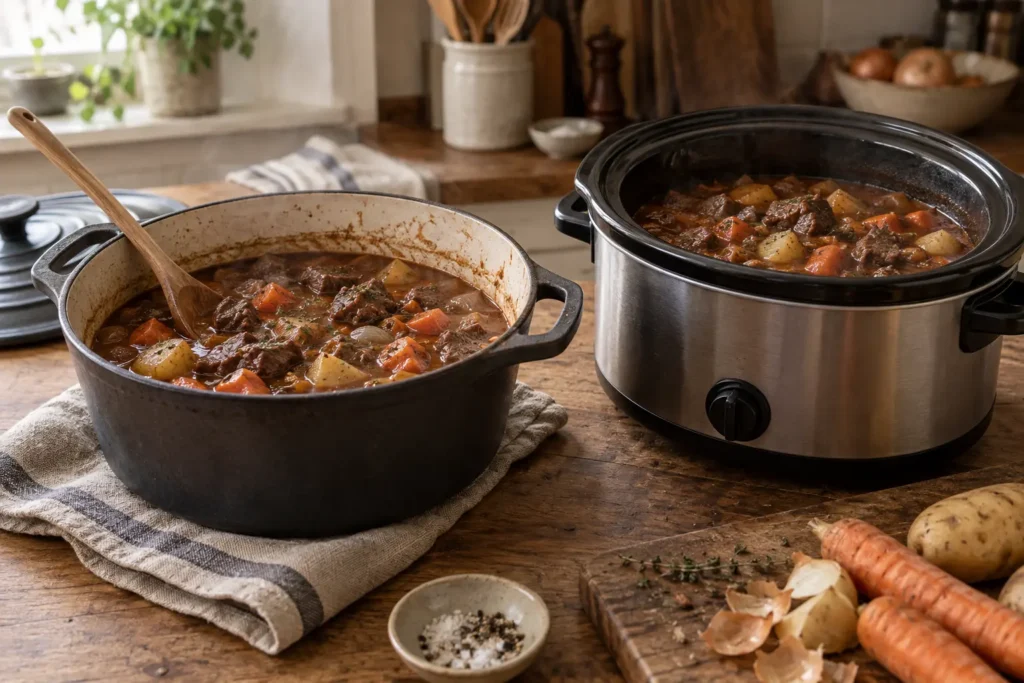
The electric slow cooker belongs to a much later age. Irving Naxon patented an early electric cooking appliance in the twentieth century; a redesigned version was marketed as the Crock-Pot in the United States in the early 1970s. Modern multicookers, including my Sage Fast Slow Pro, combine slow cooking with pressure cooking and other functions.
So the Dutch oven wins on age, but that was never really the question. Both can cook food gently over a long period. They simply do so in different ways.
Choice
I have been asked many times, ‘Should I buy a Dutch oven or a slow cooker? Which is best, and why?’ The question is not quite as straightforward as it appears because the answer depends upon how you cook.
They are not mutually exclusive. I own both, and each earns its place under different circumstances. The useful comparison is not which one is universally better, but which one better suits the dish, the day and the cook.
Taste, Browning and Sauce
A Dutch oven is wonderfully versatile. It can move from hob to oven, allowing you to brown ingredients and build a sauce in the same pot. In the oven, some evaporation and surface browning may continue, depending upon the lid, temperature and contents.
A slow cooker traps more moisture and cooks at a gentler temperature. This makes it convenient and forgiving, but sauces may remain thinner. Use less added liquid than you would for an uncovered hob or oven recipe, and remember that vegetables and meat will release liquid as they cook. Rather than applying an automatic conversion, such as halving every measure of wine, adapt gradually and follow a recipe designed for a slow cooker until you understand how your own machine behaves.
Browning meat first can create valuable roasted flavours and improve appearance, but it is not a universal food-safety requirement. If time permits, I usually consider the flavour worth the extra pan or preliminary step. Do not overcrowd the pan, and allow the surface to colour rather than steam.
Taste comparisons are personal. The appliance does not decree that chicken must taste better from one and beef from the other. Ingredients, browning, seasoning, temperature, time and evaporation all have a greater say.
Cost and Longevity
A well-made cast-iron Dutch oven can last for decades. Bare cast iron requires seasoning to protect the surface and improve its cooking performance; seasoning does not accumulate flavours that should be passed from one meal to the next. Enamelled cast iron does not require seasoning, but should be protected from severe knocks and thermal shock. A small exterior chip is not necessarily fatal, while damage to the interior cooking surface deserves closer attention and reference to the manufacturer’s guidance.
A basic slow cooker often costs less to buy, although sophisticated multicookers can cost considerably more. It may use less energy than heating a large oven for many hours, but there is no honest universal percentage: appliance wattage, oven type, cooking duration and energy tariff all matter. Check the rated power of the appliances you actually own if running cost is important to your decision.
Control and Convenience
An oven provides a wide temperature range and permits uncovered reduction, roasting and baking. A slow cooker generally offers Low and High settings, sometimes alongside temperature probes, timers or automatic keep-warm functions.
Automatic controls are convenient, but a delayed start should not be used to leave raw meat, poultry, fish, dairy or other perishable ingredients sitting at room temperature. Assemble ingredients cold, refrigerate them if preparing ahead, and begin cooking promptly in accordance with the manufacturer’s instructions. A timer that switches the machine off or changes it to a safe keep-warm setting is a different matter, but food should not remain lukewarm for extended periods.
And yes: always read the manual. Machines differ more than their familiar ceramic pots suggest.
Usage
Slow cooking long predates either appliance. Across cultures, people have used retained heat, buried ovens, covered pots and communal ovens to transform tough ingredients with time.
Cuts rich in connective tissue can become beautifully tender during long, moist cooking. Beans, pulses, soups, stews and braises are natural candidates too, although dried kidney beans require special care: they should be properly boiled according to authoritative guidance before slow cooking because undercooking can leave harmful lectins active.
The Dutch oven offers breadth: browning, frying, braising, stewing, baking and bread-making, with an attractive pot able to travel from hob to oven to table. The slow cooker offers convenience and avoids heating a full-size oven, but its insert and contents can still become extremely hot. ‘Slow’ does not mean cool, and the same care is required when lifting the lid or carrying the pot.
Points to Remember
- Use a tested recipe when learning how your appliance behaves.
- Reduce added liquid when converting a conventional recipe for a slow cooker, but do so by judgement rather than a fixed formula.
- Cut ingredients into pieces that will cook evenly.
- Keep perishable ingredients refrigerated until cooking begins.
- Brown ingredients first when you want the flavour and colour it creates.
- Add delicate vegetables, herbs, dairy or seafood later when the recipe requires it.
- Avoid repeatedly lifting a slow-cooker lid; each peek releases heat.
- Read the manufacturer’s instructions, particularly for minimum fill, preheating, timers and keep-warm settings.
Timings
There is no reliable rule saying that a Dutch oven always takes 25 per cent of a slow cooker’s time, or that a slow cooker on High always takes twice as long. The relationship changes with the recipe, quantity, starting temperature, appliance and desired result.
Use the timing in a tested recipe as your starting point. When adapting one, check tenderness and food safety rather than relying solely upon the clock. A food thermometer is especially valuable for large joints and poultry.
Verdict
I have not chosen one over the other. I have both, and they live harmoniously in the same kitchen.
If you must choose, consider:
- how much active cooking time you have;
- the range of techniques you want to use;
- purchase and running costs;
- the space available for storage;
- whether you value unattended convenience or hob-to-oven versatility.
Buy the best-made appliance that fits your needs and budget, but do not feel obliged to spend an arbitrary extra ten per cent. A modest slow cooker used every week is a better purchase than a prestigious pot that never leaves the cupboard.