
Ravioli, singular: raviolo, are a type of pasta comprising a filling enveloped in thin pasta dough. Ravioli are commonly square, though other forms are also used, including circular and semi-circular (mezzelune). The word ‘ravioli’ means “little turnips” in Italian dialect, from the Italian rava meaning turnips, from the Latin rapa.
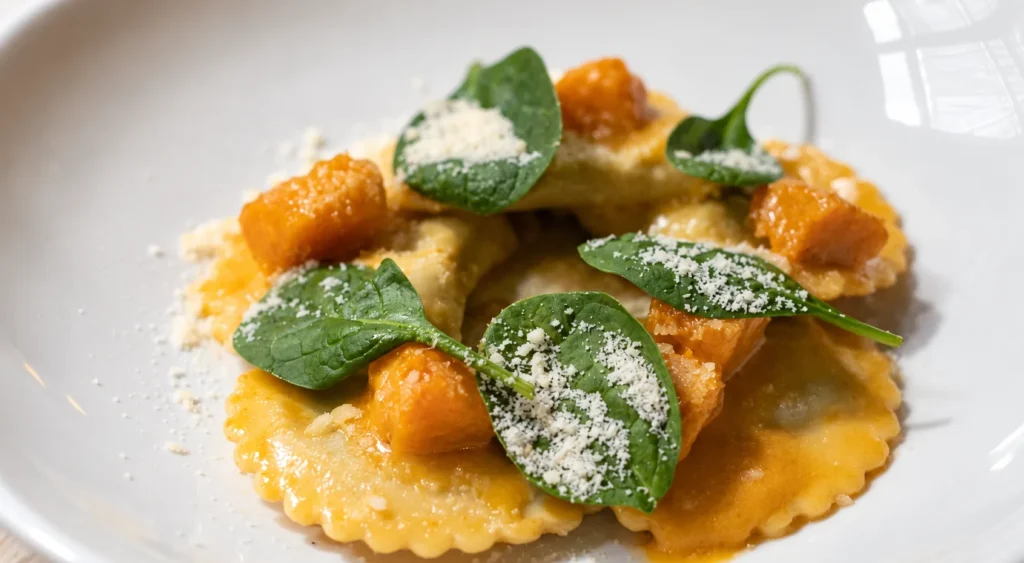

Homemade Fresh Ravioli (Pasta Gialla)
Ingredients
Dough
Filling
Instructions
-
Begin with a mound of flour on a wooden board and make a well in the centre to form a crater. Crack the eggs into the centre, start whisking with a fork to combine, slowly incorporate more of the flour from the edge until you’re left with a thick, gooey paste.Make the flour well wide and sturdy enough to contain the eggs. If the wall begins to break, use the fork or scraper to pull flour back around the liquid before it escapes across the board.
-
When the paste is formed but too sticky to work with just a fork, use a dough scraper to incorporate more of the flour, almost scooping the edges into the centre. Using your hands press the mixture together to form the dough and knead for at least 10 minutes.
-
To knead, drag the dough forward with your palm, using the other hand to hold it steady. Pull the stretched dough back over, rotate and start again. Repeat the process until you have a firm, smooth consistency. Wrap the dough in a tea towel and set aside to rest for about 20 to 30 minutes at room temperature.Resting allows the flour to hydrate and the gluten to relax. The dough should feel smoother and noticeably easier to roll afterwards.
-
Once rested, unwrap the dough, cut in half and press it down with your hands to flatten. Cover the remainder with the tea towel to prevent it drying out.
-
Assemble your pasta machine, setting the dial to its widest. Feed the flattened sheet of pasta through the machine at least 3 times before moving onto the next setting downwards. Repeat the process making your way from the thickest to the thinnest setting.Dust only as needed to prevent sticking. If the sheet becomes tacky or ragged, pause and dust lightly rather than forcing it repeatedly through the rollers.
-
To create the filling, place the ricotta in a bowl, and coarsely chop half the basil leaves and zest the lemon. Combine and incorporate all three. Scoop the ingredients into a piping bag with a spoon.If the ricotta is very wet, drain it before mixing. Excess moisture makes the ravioli harder to seal and increases the chance of them opening in the pan.
-
Cut your sheet in half and lay both strips adjacent. Sparingly wet the edges of your strip of pasta with a pastry brush or by hand. Using the piping bag, carefully squeeze the filling in a line down the centre of one of the strips about 2" or 5cm apart.
-
Place the other strip directly on top. Before finally sealing, gently press on the dough around the filling to eliminate all excess air. Next, very lightly moisten the dough with your hands and press it firmly closed.
-
Take a square ravioli or circular pastry cutter and press firmly on the dough around the filling. Finish with a final dusting of flour to keep your ravioli from sticking together.
-
Boil a large pan of generously salted water. Carefully place your (fresh or frozen) ravioli into the pan and cook for 3 minutes (4 if frozen). They will start to rise to the top by the time they’re ready.Treat floating and the stated time as guides rather than the sole test. The pasta should be tender but retain some bite, and frozen ravioli may need longer depending on their size and filling temperature.
Nutrition Facts
Servings 4
- Amount Per Serving
- Calories 526kcal
- % Daily Value *
- Total Fat 12.6g20%
- Saturated Fat 6.0g30%
- Cholesterol 217mg73%
- Sodium 136mg6%
- Potassium 256mg8%
- Total Carbohydrate 78.0g26%
- Dietary Fiber 2.8g12%
- Sugars 1.3g
- Protein 22.6g46%
- Vitamin C 0.7 mg
- Calcium 200 mg
- Iron 2.4 mg
- Vitamin D 40 IU
* Percent Daily Values are based on a 2,000 calorie diet. Your daily value may be higher or lower depending on your calorie needs.
